
A motorcycle coming out of several weeks in storage needs different attention from one ridden every day. Fluids deteriorate, seals lose their flexibility, and some faults remain hidden until the engine is running under load. Before even considering road safety or equipment, it’s the return to service after a period of inactivity that causes the most insidious breakdowns.
Motorcycle in storage: checks that a visual inspection can’t replace
A walk-around before setting off can reveal a flat tire or a burned-out light. It won’t detect brake fluid contaminated with moisture, engine oil whose additives have separated through settling, or brake pads saturated with moisture and no longer providing adequate bite.
After several months without riding, hygroscopic brake fluid (DOT 4 on most motorcycles) absorbs moisture from the air. Its boiling point drops. A short downhill stretch that puts the brakes under strain for a few miles can cause vapor lock—something that would have been impossible to anticipate in the garage. We recommend bleeding the system and replacing the fluid whenever a motorcycle has been stationary for more than six months, without exception.
Fuel also goes stale. Gasoline loses its volatile components within a few weeks, forms deposits in the fuel system, and can clog the injectors. On a carbureted motorcycle, the process is even faster: the jets clog and the float bowl gums up. Draining the tank or using a fuel stabilizer before winter storage remains the only reliable solution.

The tire sidewalls deserve particular attention. Rubber hardens even when there’s no visible wear. A tire more than four years old, based on its manufacturing date (the DOT code on the sidewall), loses grip, especially on wet roads. A tire that looks intact but has hardened is still a major risk. A quick visual check can’t measure the hardness of the rubber compound.
Finally, the battery is more than just an accessory. A deeply discharged battery (below 12.4 V at rest) can develop sulfated plates, sometimes irreversibly. Connecting a smart charger while the motorcycle is in storage—or at least checking the voltage with a multimeter before turning the key—can prevent an unpleasant surprise. On modern motorcycles equipped with ABS and traction control, unstable voltage can also trigger random electronic faults.
For more information on these points and other practical topics, Mon Guide Auto’s motorcycle advice covers a wide range of common situations.
Chain and drivetrain maintenance: how often, depending on use
The chain accounts for a disproportionate share of mechanical problems on the road because it’s exposed and often neglected. A dry chain stretches two to three times faster than a properly lubricated one.
Lubrication isn’t just a matter of spraying on lubricant after every ride. The right approach is to clean the links first with a suitable degreaser (don’t use harsh solvents on an O-ring chain), let them dry, then apply lubricant to the inner side of the links, with the motorcycle on its center stand or a paddock stand, turning the rear wheel by hand.
- Check chain tension against the specification on the swingarm or in the owner’s manual—not by guesswork
- Check the countershaft sprocket and rear sprocket for wear: hooked teeth indicate that the entire chain and sprocket kit needs replacing soon
- Inspect the O-rings (or X-rings): a split seal lets the grease inside the link escape and accelerates wear throughout the drivetrain
For a motorcycle ridden daily, lubricating the chain every 500 to 800 km (or after every ride in the rain) keeps the drivetrain in good condition. For a motorcycle ridden infrequently, the opposite problem can arise: the chain dries out between rides and develops surface rust. A light application of lubricant before storage offers better protection than applying a heavy coat when you return.
Engine oil and filtration: adjust the interval to actual mileage
Manufacturer-recommended oil change intervals assume regular use. Oil also deteriorates through oxidation, even when no miles are ridden. An engine that hasn’t run for six months contains oil whose anti-wear and detergent properties have weakened.
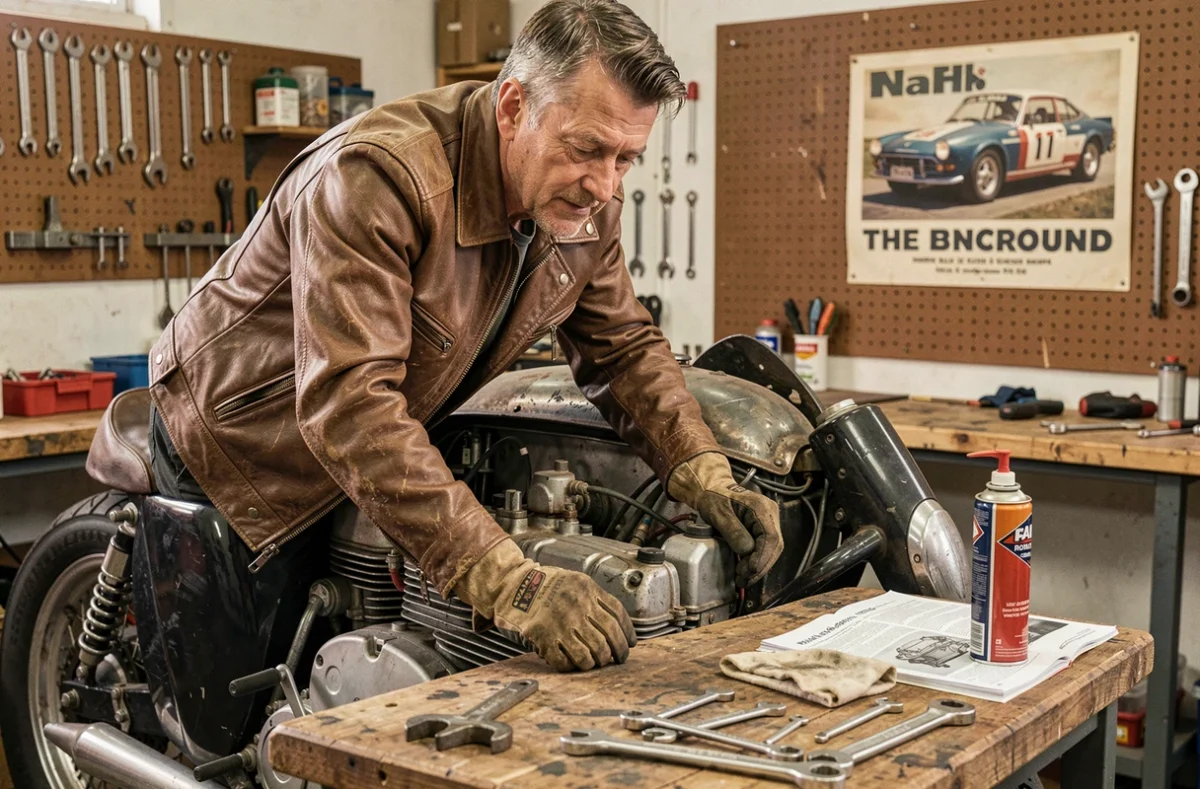
Changing the engine oil and filter at least once a year, regardless of mileage, is good practice for motorcycles used intermittently. The oil filter traps combustion residue and microscopic metal particles. Leaving it in place for more than a year, even with low mileage, risks saturating the filter media and reducing oil flow under pressure.
Coolant follows the same principle. Its corrosion-inhibiting properties diminish over time, not just from accumulated heat. In aluminum engine blocks (used in most modern engines), degraded coolant can damage the cylinder head gasket surfaces and internal passages.
Motorcycle tires and pressure: the most overlooked safety factor
Tire pressure directly affects the contact patch, cornering stability, and braking distance. A tire underinflated by half a bar noticeably changes a motorcycle’s handling.
Check tire pressure when the tires are cold and the engine has been off for at least two hours. Reference pressures are listed on a label attached to the swingarm or under the seat, and vary depending on the load (riding solo or two-up). A personal dial or digital gauge is more reliable than those at gas stations, costs little, and fits in a seat bag.
- Check tire pressure at least once every two weeks during regular use, and always before riding after the motorcycle has been in storage
- Inspect the tread for nails, screws, or cuts that haven’t yet caused a noticeable loss of pressure
- Replace missing or cracked valve caps to prevent dust from getting into the valve mechanism
If a motorcycle has been left on its side stand for several weeks, the rear tire may develop a slight flat spot. Riding a few miles at a moderate speed is usually enough to restore its normal profile, but a flat spot that persists after about ten miles means the tire needs replacing.
Motorcycle maintenance isn’t just a list of periodic tasks scheduled according to the odometer. Time in storage, storage conditions, and fluid quality matter just as much as mileage. A motorcycle that’s ridden infrequently may require more attention than one ridden every day.